






Latest Articles from the world of Artificial Intelligence

23 October 2026
Home-Cooked Images with ComfyUI
Generating an image with an online service costs little, but it costs every single time. You pay for it in credits that run out mid-month, in free plans that recharge whenever they feel like it, and in rules about what you can and cannot ask for established by someone else. Midjourney, DALL-E, and Firefly are remarkable tools, but they share the nature of a rental: the house is splendid, but it isn't mine. That's where this experiment started—born as a personal trial and becoming an article along the way. I wanted to see if I could produce images without per-shot costs, without dwindling meters, and without credit limits, using only the computer sitting on my desk.

21 October 2026
AI Agents Push Humans Out of the Loop
A new position paper authored by Margaret Mitchell, Avijit Ghosh, and Samir Passi argues that AI agents do not merely make oversight harder: their prolonged use can erode the very skills required to exercise it. In Italo Calvino's *The Nonexistent Knight, the most scrupulous paladin in Charlemagne's army is Agilulf, a suit of white armor with nobody inside. He exists purely through willpower, knows the regulations by heart, is always at his post, and never gets a formality wrong. It is a fitting portrait of the human in the loop when their presence is merely formal: present on the organizational chart, on the form, on the button, but lacking the time, information, and competence inside to decide.*
19 October 2026
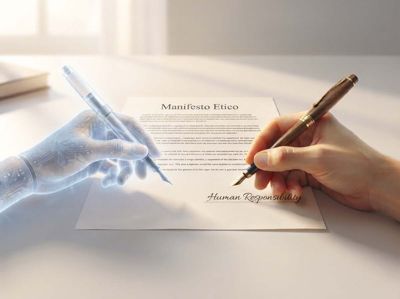
Interview with Fulvio Julita on the Ethical Manifesto for Writing with AI
I discovered the Manifesto a week ago, by chance, while scrolling through social media. It struck me as an opportunity to test the method I've built in recent years, which I describe on AITalk's editorial method page. The comparison was twofold. First manually, reading the ten principles alongside my daily practice. Then using a Skill, a small personal tool I built to cross-reference my methodology and some of my work with the Manifesto's text, because I wanted to see if I had been indulgent with myself.

16 October 2026
Algorithmic Monoculture: One AI for Everyone, Risk or Remedy?
Two studies published just months apart seem to say opposite things. Looked at closely, they measure different things. Kyle Behm kept submitting job applications and receiving the exact same rejection. In Cathy O'Neil's account in Weapons of Math Destruction, picked up by the MIT paper, Behm only discovered at the end that all the companies were using the same screening system, which apparently penalized him for a mental health condition. They were not many independent judgments; it was a single judgment repeated everywhere.

14 October 2026
The Fideuram Case: The Voice Is No Longer Proof
This article comes out days after the news broke, not out of laziness, but by choice. The case emerged on September 25, filled the financial news pages for two days, and then, as always, slipped away. Waiting for the sensationalism to settle allows us to look at the facts with greater clarity, without the rush of sensational headlines. That is what we are attempting to do here. There is a question that anyone who has ever made an online wire transfer asked themselves reading this story. To transfer two hundred euros from their own bank account, an ordinary user must pass two authentication factors, a temporary code, and sometimes a call from the bank if the amount is unusual. Yet a C-level executive, with decades of banking experience, authorized within a few hours a transfer of nearly 95 million euros based on a WhatsApp message and a phone call. It is not a naive question. It is probably the most useful question one can ask about this affair.

12 October 2026
MiniCPM5-2B: Lightning Fast, Great at Coding, Less So Elsewhere
In recent weeks, the name MiniCPM5-2B has circulated across timelines, newsletters, and local AI Discord channels with a frequency suspicious for a model with just 2.5 billion parameters. According to its official model card on Hugging Face, the model scores 97.1 on τ²-Bench Telecom, 69.1 on LiveCodeBench v6, and 86.5 on AIME—numbers that, in comparisons published by the authors themselves, surpass those of 4B models like Qwen3.5-4B. Artificial Analysis, which independently re-ran part of the benchmark suite, confirms that this is the highest score on its Intelligence Index among all open-weight models under 4 billion parameters. The simple question worth asking before repeating the phrase "competes with models four times its size" is: does it truly compete, and on what?

09 October 2026
Empero and Distillation: I Tested Their Qwen3.8-35B-A3B
When an independent lab promises to transfer the reasoning of a frontier model into a file you can download and run on your own PC, the right question is not whether it succeeded on paper, but how much of that promise stands when the file actually lands inside consumer RAM. This is the question that guided previous installments of this series, from Qwen 3.5 9B to Qwen 3.6 35B, and today it returns with a different protagonist: not an official model from a billion-dollar lab, but a German project called Empero and its distilled creation, Qwen3.8-35B-A3B-Distill.

07 October 2026
A Guide to Quantization Formats for Local LLMs
In Borges' parable of the empire and its map, the cartographers end up drawing a map as large as the territory itself, only to discover that it is useless. A 16-bit language model is that map: perfectly faithful, 1:1 scale, but far too unwieldy to fit on your desk. Quantization is the art of shrinking the scale without losing the roads that matter, and in 2026, the tools to do so are so numerous that they require a glossary before you even begin choosing. Following the guide to inference engines, this piece brings order to the formats: what they are, what they cost in terms of quality, and which hardware they suit best.

05 October 2026
Vincenzo Fornaro and Colibrì: "I'm Not Interested in Genius, I'm Interested in Curiosity"
I have already written about Colibrì, telling how it is possible to run a 744-billion-parameter Mixture-of-Experts model on a computer with barely 25 GB of RAM, treating the disk as an intelligent memory tier rather than a simple storage bin (you can read the full technical analysis here). What was missing was the voice of the person who wrote that engine, one C file at a time, alone, without a lab or a cluster behind him. I chatted with Vincenzo Fornaro to hear the story behind the code, and the conversation turned out to be longer and more inspiring than I had anticipated.

02 October 2026
Authority Is Not Possessed, It Is Inherited
Imagine an AI agent asked to summarize a document. The task seems harmless: read, summarize, return a shorter text. But the document contains, hidden between the lines, an instruction that does not come from the user: delete this file, exfiltrate that secret. This is one of the scenarios that computer scientist Nicola Gallo uses in his paper Proof-of-Continuity: A Temporal Model for Authority Propagation in Distributed Systems and AI Agents, published on arXiv on July 9, 2026, and it is useful to start right there because it shows precisely where the problem lies.

30 September 2026
Jev Doesn't Chat, It Decides
Just days after its launch, a model that doesn't write a single word forces us to ask what artificial intelligence is truly for. Models have been superhuman in chat for years, so where is the automation? That is the question Diogo Almeida opens with in the launch post for Jev, published on September 15, 2026, saying he has been chasing it for four years. He leads TypeSafe, a young San Francisco startup that, according to The Register and TS2, raised $40 million in a round led by DCVC.

28 September 2026
The Navier-Stokes Theorem: Big Tech Between Understanding, Verifying, and Pacing
I waited a few weeks for the dust of controversy and hype to settle before trying to tell what really happened with Navier-Stokes. In the first few days, headlines split into two opposing camps: "Artificial intelligence has solved a Millennium Prize Problem" on one side, "No, they just stole the work of two mathematicians" on the other. Both reflect the tone of the event, not the facts. And the facts, lined up, tell a story far more interesting than any headline. There is also a thread linking this story to another that arrived just days later—the essay in which Dario Amodei called for pacing AI development: the same question about what in these corporate narratives is verifiable and what remains mere promise. We will get there after the math.
25 September 2026
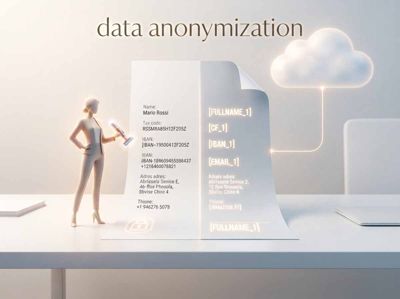
Data Anonymization and the Italian Solution
Every time a lawyer pastes a contract into ChatGPT to summarize a clause, or an accountant asks Claude to review a financial statement, something happens that neither of them really notices: a tax code, an IBAN, or a client's name crosses a border. Not just a geographic border, but a legal one. They leave the protected perimeter of the company and end up on the servers of a provider that, in most cases, is located elsewhere, sometimes in jurisdictions where guarantees remain to be verified. The topic is data anonymization, and with generative AI, it has shifted from a niche technical matter to an everyday problem for anyone writing a prompt containing real information.
23 September 2026
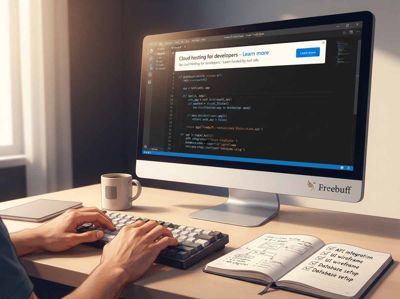
Freebuff: The Free Coding Agent Powered by Ads
In our piece comparing open-source coding agents, we talked about OpenCode and Pi Agent, among others—two free tools that require no login and never touch your credit card. The question left hanging was about frontier models, the ones that are truly expensive to serve. Can you offer a free coding agent without strict limits using the same models that power products costing hundreds of dollars a year? Freebuff tries to answer yes, with a bet that until recently would have seemed bizarre even in the developer tools world, famously allergic to any form of advertising: paying the bills with text ads slipped in between agent turns.

21 September 2026
Token Economy: How China Is Monetizing AI
Banks, carriers, and local governments are using AI tokens as perks, mobile plans, and credit metrics—it works, but the risks are real. That is what is happening in China in the summer of 2026. AI tokens—the compute units through which language models read and write text—are leaving the developer console to slip into everyday life: credit cards, phone bills, and even the tab at a neighborhood deli.